
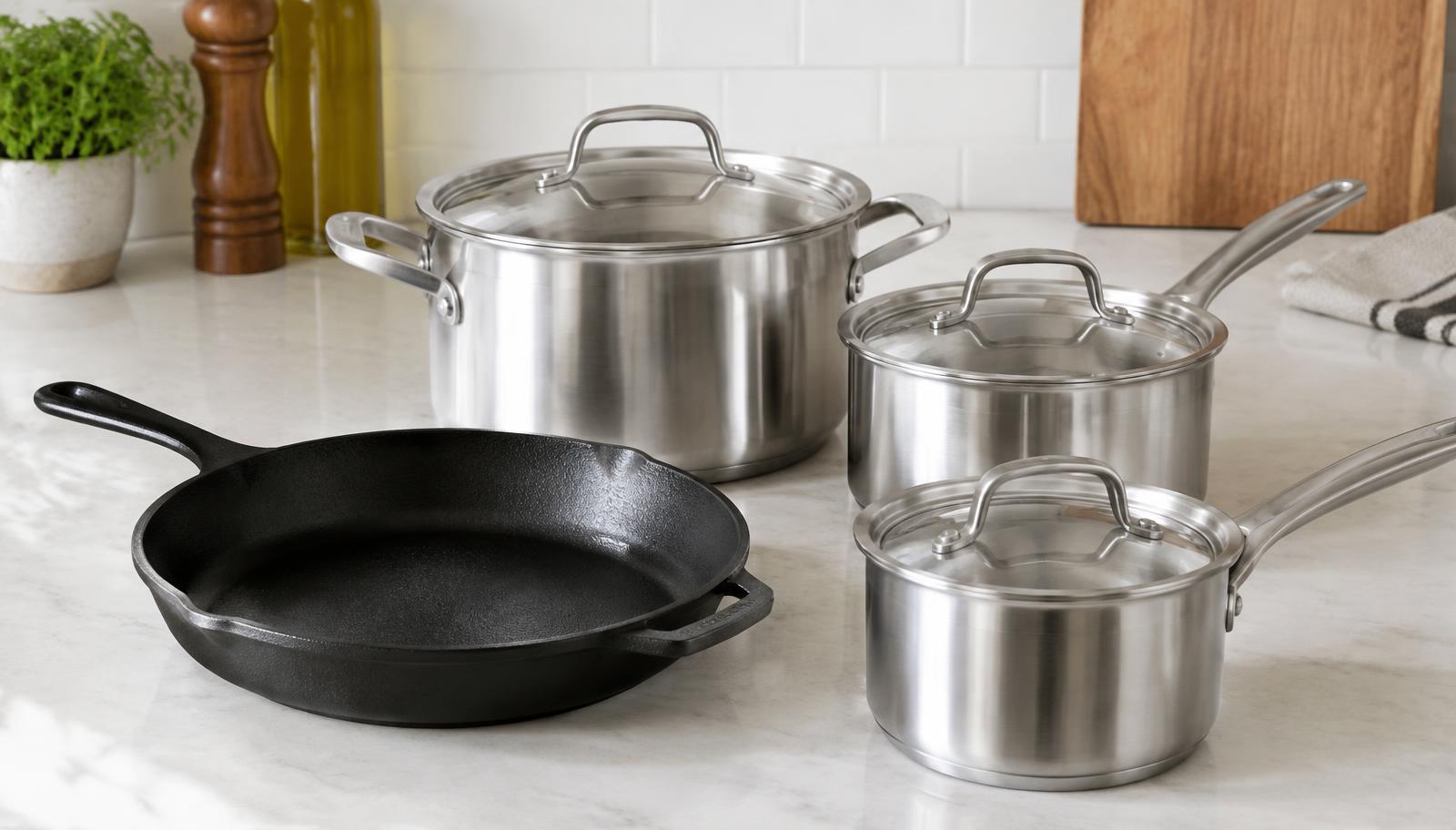
Define the range and its intended cooking tasks
Begin with the customer, cooking task and intended sales channel rather than a catalog photograph. A hospitality skillet, family casserole and premium saucepan need different performance priorities even when their selling prices overlap. Define heat sources, expected cleaning methods, warranty positioning and target retail price before requesting quotations. Translate that positioning into a specification that suppliers can price consistently and inspectors can verify.
Specify capacity, rim diameter, base diameter, overall height and target weight with agreed tolerances. Include lids, handle geometry, attachment methods, surface finish and packaging configuration. Separate essential requirements from options that suppliers may quote independently. Otherwise, a low quotation for a thinner body or lighter lid can appear equivalent to the product the buyer actually intends to sell.
Specify cast iron and stainless steel constructions
For cast iron, address casting integrity, wall consistency, base flatness, surface texture and handle design. Define the seasoning system and appearance standard for preseasoned pieces without suggesting that seasoning is a permanent nonstick coating. For enamelware, identify interior and exterior coating systems and approved color references. Establish permissible cosmetic variation using physical samples, because photographs rarely communicate surface texture or gloss reliably.
Stainless cookware needs a construction drawing as well as an alloy description. Identify the food-contact layer, any aluminum or copper core, the external layer and whether construction uses an encapsulated base or fully clad walls. A three-ply description does not establish individual layer thicknesses or heating performance. Specify rim treatment, handle attachment and intended heat-source compatibility, then verify those requirements on representative samples.
Verify supplier roles and production capability
Identify the legal entities that quote, manufacture and export the order, and reconcile those names across commercial documents. A trading company can be suitable when its role and access to manufacturing records are transparent. Map casting or forming, polishing, coating, seasoning, assembly and packing locations. Outsourced finishing deserves particular attention because process changes can affect appearance, traceability and the evidence supporting compliance.
Request an assessment matched to the product risks rather than relying on a general factory presentation. Review relevant equipment, maintenance, incoming-material controls, production records and corrective-action practices. Source & Brand coordinates sourcing, OEM/ODM development, private label programs and supplier verification, but it does not own factories or issue inspection certificates. Buyers should approve specifications and use qualified independent providers where laboratory testing or formal inspection is required.
- Confirm company identity and production responsibilities.
- Assess the relevant manufacturing and outsourced processes.
- Verify critical claims before approving production.
Build a destination-specific compliance and testing plan
Food-contact obligations depend on the destination, materials, finishes and intended use. Ask a qualified laboratory or regulatory adviser to identify applicable requirements and test conditions before finalizing construction. Enamel, decorative coatings and other components may need separate consideration. A generic food-safe statement does not demonstrate that every size, color and finish in a proposed range has an adequate compliance basis.
Match reports to the actual manufacturer, product reference, material specification and tested configuration. Agree when changes require technical review or retesting, rather than treating documentation as permanently valid. Separately define performance methods for handle security, stability, thermal cycling, corrosion resistance and other design-specific risks. Numerical acceptance criteria should be established before testing so that buyers and suppliers do not interpret acceptable performance differently after a failure.
Approve samples through controlled development gates
Use early prototypes to resolve geometry and ergonomics before treating them as production approvals. Evaluate lid seating, pouring behavior, handle clearance and lifting with a representative filled vessel. Check base stability before and after an agreed heating cycle. A highly polished development sample is not evidence that routine production can reproduce its dimensions, finish or material construction consistently.
Approve a controlled drawing, reference sample and finish standard together, recording any unresolved deviations. Establish whether samples use final tooling and the same processes planned for bulk production. Retain matching references with the buyer and manufacturer to reduce later appearance disputes. Require written authorization for changes to materials, coatings, tooling or subcontractors, even when a supplier describes a proposed substitution as equivalent.
Example
Illustrative comparison of equal quotations
Illustrative numbers: two suppliers quote a saucepan at $18, but one specifies a 2.5 mm clad wall and the other a 2.0 mm wall. The buyer aligns drawings, lid weights and performance requirements before negotiating. Identical prices did not establish identical value.
Compare tooling commitments and landed costs
Separate tooling, sample development, unit prices, packaging, testing and inspection in each quotation. Document tool ownership, identification, storage, maintenance and release arrangements if the relationship ends. A proprietary handle or knob can require separate tooling from the cookware body. Clarify minimum purchase commitments and whether any tooling charge is refundable or amortized through later orders before making the initial payment.
Compare landed economics using the same quantities, packing assumptions and named Incoterm with its location. Include freight, insurance where applicable, duties, destination handling and compliance-related expenses. Heavy cast iron can challenge parcel economics, while bulky sets can consume shipping space before weight limits are reached. Ask a qualified customs broker to confirm classification and import treatment; Source & Brand coordinates logistics but does not act as customs broker.
Set inspection criteria and protective packaging
Use inspection stages that address actual risks, including incoming materials, critical manufacturing operations and final packed goods. Agree defect classifications, sampling rules and escalation procedures before production. Random sampling does not guarantee every unit is defect-free, and safety-critical characteristics may require dedicated controls or complete checks. Specify who may release a shipment and what evidence is necessary after rework or a failed inspection.
Test packaging against the intended distribution route rather than factory handling alone. Separate surfaces that could rub, secure lids and protect handles and enamel-coated edges against impact. Assess moisture protection for seasoned iron and verify that care instructions explain appropriate drying and storage. Add readable lot identifiers so complaints can be connected to production records without opening every shipping carton.
Purchase-order release checks
- ✓Controlled drawings and materials are approved.
- ✓Required reports match the intended product and market.
- ✓Reference samples establish finish limits.
- ✓Packaging and care instructions are verified.
- ✓Inspection, corrective action and release responsibilities are documented.
Launch with traceability and controlled replenishment
Build the schedule around material approval, tooling readiness, sample signoff, production capacity and inspection availability. Confirm which events start the quoted lead time and how delays will be escalated. Preserve time for corrective action rather than allowing shipping urgency to override acceptance criteria. Payment milestones should distinguish development authorization from approval to manufacture saleable bulk units, especially for an untested design.
After launch, classify complaints so rust, enamel damage, loose handles and base distortion can be investigated separately. Review returned products where practical and distinguish manufacturing defects from damage or care-related issues using evidence rather than assumptions. Feed recurring findings into corrective actions before replenishment. Maintain specification revisions and lot records so the next order reproduces the approved product instead of restarting development informally.
For cast iron cookware, agree the surface finish, seasoning or coating process and expected appearance before judging samples. Identify which variations are cosmetic and which affect cooking, handling or corrosion. Check lid fit, base stability and handle attachment on representative production pieces. Heavy cookware also needs packaging that restrains movement without allowing the product to strike the carton walls. Test a complete packed unit rather than approving cushioning by material name. Include storage and care instructions that match the actual finish supplied.
For stainless steel cookware, define the grade and the construction of the base separately. A claim of stainless steel does not describe layer thickness, bonding quality or compatibility with the intended heat source. Review any performance or food-contact claims with the relevant specialist and test the finished product where required. Ask how production checks identify unstable bases, sharp edges and loose handles. Keep material evidence and finished-product inspection records linked to the batch. Comparing products by shine or weight alone can conceal differences in geometry, construction and safe handling.
Frequently asked questions
Is cast iron always cheaper than stainless steel?
No; construction, finish, packaging, weight and order quantity all influence cost. Compare matched functional requirements and landed costs rather than assuming the base material determines the final price.
Can one report cover an entire cookware range?
Not automatically. Ask a qualified laboratory whether variations in materials, coatings, colors and construction can be grouped and which representative products require testing.
How should induction compatibility be checked?
Test finished samples on representative equipment using an agreed method. Magnetic response alone does not demonstrate heating uniformity, stability or compatibility with every appliance.
What should tooling agreements include?
Identify the tools and document ownership, maintenance, storage and release responsibilities. Address permitted use for other customers and obtain appropriate legal review for important ownership provisions.
When should production be approved?
Approve bulk production after essential supplier checks, specification alignment and the agreed sampling gates. Link payments to documented milestones rather than treating a deposit as an unrestricted authorization.
Key takeaway
Reliable cookware sourcing combines controlled construction specifications, destination-specific compliance review and representative testing. Compare suppliers on the same technical and commercial basis, then preserve that agreement through inspection, traceability and change control.