
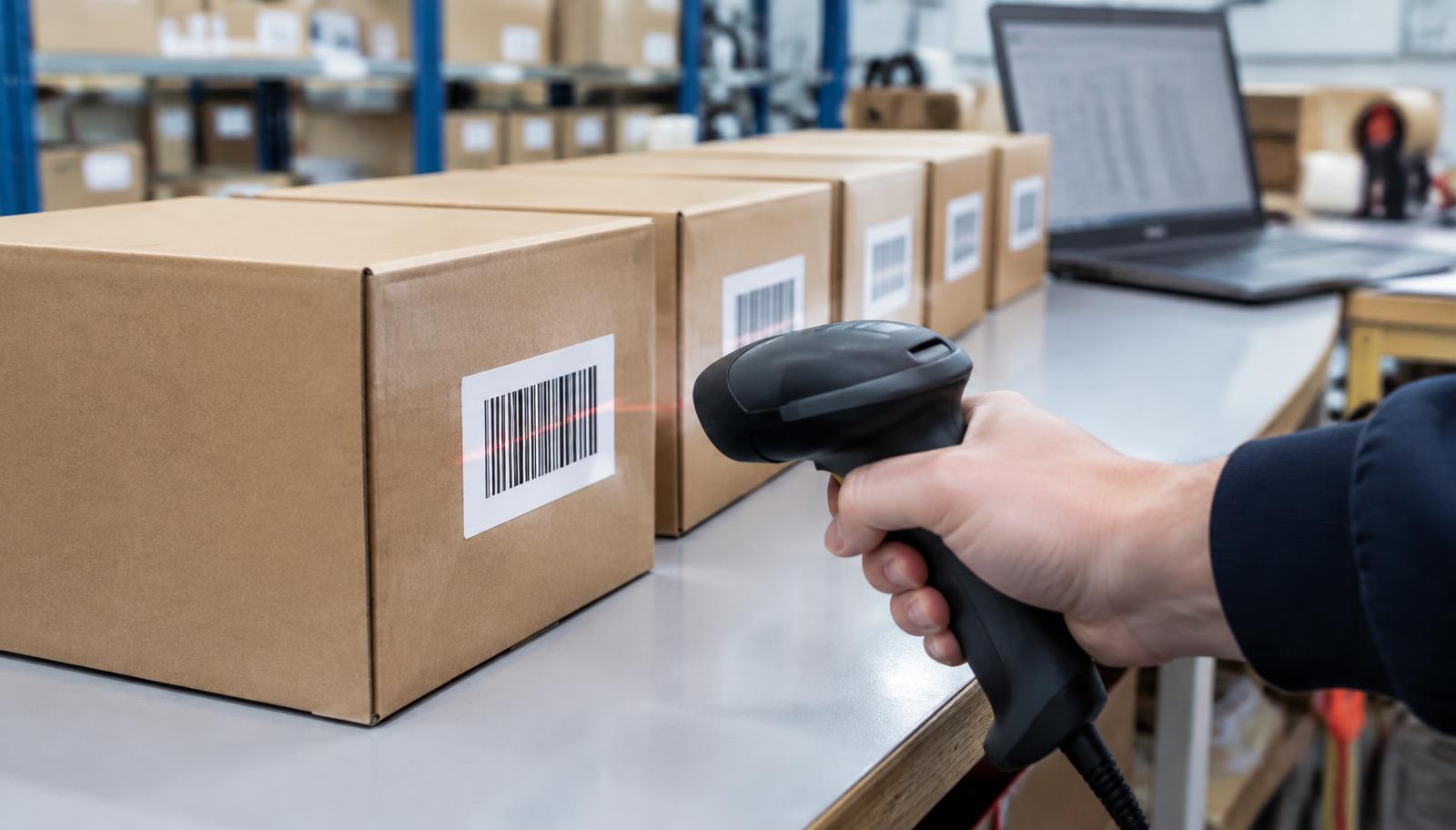
Separate Product Identity from the Printed Barcode
A product label has several jobs: identify the item, communicate required information and help trading partners handle it correctly. Treating every number or symbol as interchangeable creates avoidable listing and receiving problems. Start by separating the commercial identity of the product from the graphic that carries that identity.
A Global Trade Item Number, or GTIN, identifies a trade item within the GS1 system. A barcode is a machine-readable data carrier that can encode that identifier, sometimes alongside other information depending on its format. Your internal stock keeping unit, or SKU, serves your own inventory structure and does not replace a GTIN when a retailer requires one.
Common retail symbols include UPC-A and EAN-13, while logistics applications may use different carriers and identifiers. A QR code linking to a website is not automatically a substitute for a checkout barcode. Ask each sales channel which identifier and symbol it accepts before committing to artwork.
Secure GTINs Through the Appropriate GS1 Route
For an own-brand product, the brand owner generally takes responsibility for assigning GTINs under the applicable GS1 rules. Contact the relevant GS1 member organisation to understand licensing options, allocation capacity and ongoing obligations. Requirements and commercial arrangements can vary by location, so avoid assuming another seller’s registration route applies to you.
- List the legal business name, brand name, intended markets and expected product range before applying.
- Choose an official GS1 allocation option that covers the launch and realistic additions, including packaging levels where applicable.
- Record each assigned identifier against one defined trade item and maintain the supporting allocation records.
- Check that channel submissions and product data accurately reflect the licensed company and brand relationship.
Do not adopt a supplier’s existing number merely because it already appears on a sample carton. That number may identify another brand’s item or packaging configuration, leaving you with mismatched records. Similarly, inexpensive third-party numbers can create ownership or acceptance difficulties; establish channel requirements before purchasing anything.
Map Variants and Packaging Levels Before Design
Build an identifier matrix before designers place barcode graphics. Colour, size, quantity and other commercially meaningful differences can require separate GTINs under the GS1 GTIN Management Standard. A change in formulation, declared net content or pack quantity also needs review rather than an automatic decision to retain the existing number.
Distinguish a consumer unit from an inner pack, a case and a logistics unit. A case ordered as a trade item may need its own GTIN, while an individual logistics unit can be identified with an SSCC where the relevant process requires it. One code copied across every packaging level rarely provides the information a distribution operation needs.
Example
Illustrative allocation plan
Illustrative numbers: a brand launches three bottle colours in two capacities, creating six consumer variants. If each variant also ships in a separately ordered case of twelve identical bottles, the team evaluates six additional case-level GTINs. It records each relationship in the product master rather than printing consumer-unit identifiers as though they identify the whole case.
Build a Market-Specific Label Content Matrix
Barcode acceptance does not prove that a product label is legally compliant. Required wording depends on the destination, product category, material and intended user. Food, cosmetics, electrical goods and children’s products can have very different obligations, including language, warnings, traceability details and responsible-party information.
Create a matrix linking each market and SKU to the applicable labelling requirements and the evidence used to confirm them. Assign a named owner to resolve uncertain claims or symbols with a qualified specialist. Do not add certification marks, recycling symbols or environmental claims simply because they appear on a competitor’s packaging.
Keep variable manufacturing information separate from permanent design elements. Batch identifiers, manufacturing dates, expiry dates and serial numbers may require controlled printing during production, depending on the product. Specify their location, format and durability so a supplier does not place them over warnings or the barcode’s clear space.
Control Barcode Artwork and Print Conditions
Generate barcode artwork from validated data using suitable software or a competent service. Do not draw bars manually, stretch an image to fill a gap or rely on a screenshot from a marketplace listing. Confirm the required symbol dimensions, quiet zones, contrast and placement against the applicable GS1 specifications and receiving-channel rules.
Packaging materials affect performance as much as the original file. Curves, seams, glossy coatings, transparent films and dark substrates can interfere with scanning or reduce print contrast. Have the printer account for its process, including bar width adjustment where appropriate, rather than making arbitrary changes during layout.
- Approve the encoded data against the controlled identifier matrix before reviewing appearance.
- Review a full-size artwork proof showing dimensions, quiet zones, surrounding graphics and the actual packaging panel.
- Evaluate a production-representative printed sample on the intended substrate and finish.
- Require approval for any later change to barcode size, placement, ink, material or print method.
Verify Symbols and Test the Receiving Workflow
A successful scan on a phone or one warehouse scanner is useful, but it does not establish print-quality compliance. Formal barcode verification measures defined characteristics using appropriate equipment and standards for the symbol type. Where a retailer specifies a verification grade or report, include that requirement in the purchase specification and agree who will obtain it.
Check the decoded data as well as the printed quality. A perfectly printed symbol can still point to the wrong size, case quantity or marketplace record. Run a receiving simulation that connects the physical sample, product master and channel listing, and confirm that staff can distinguish similar variants without guessing.
Set production checks around realistic failure points, such as a new print roll, supplier change or packaging revision. Agree how unreadable or misassigned labels will be isolated, corrected and rechecked before shipment. Keep records tied to the purchase order and packaging revision so a later complaint can be investigated.
Use a Single Release Checklist Across Suppliers
Make label release a documented handoff between commercial, design, compliance and production teams. Email approval of an attractive mock-up is not enough if no one has checked the encoded number or required wording. Give the supplier one controlled release package and explicitly withdraw obsolete files.
Before authorising label production
- ✓Each SKU and relevant packaging level has a reviewed identifier assignment.
- ✓The encoded barcode data matches the product master and channel submission.
- ✓Market-specific mandatory text, languages and substantiated claims have been reviewed.
- ✓Artwork specifies barcode dimensions, clear space, colours and placement.
- ✓Variable batch or date information has a defined printing area and format.
- ✓Production-representative samples and any required verification reports are accepted.
- ✓The purchase order identifies the approved artwork revision and change-control process.
State who pays for corrections when production departs from approved specifications, while distinguishing supplier errors from buyer-requested changes. Agree whether rework needs fresh sampling or independent inspection. This makes corrective action a purchasing decision supported by evidence instead of a rushed argument at dispatch.
Maintain Label Data as the Range Expands
Treat the product master as an operational record, not a launch spreadsheet that disappears after delivery. Keep identifiers, dimensions, declared quantities, artwork revisions and market approvals connected. When a product changes, assess both whether a new GTIN is required and whether sales channels need updated content.
Source & Brand can coordinate sourcing, private label development, supplier verification and logistics handoffs so approved label requirements reach the relevant partners. It does not replace your GS1 organisation, legal adviser or specialist compliance reviewer. Keep ownership of identifier allocation and final label approval clearly assigned within your business.
Test barcode readability on the final printed and packed item, not only the artwork PDF. Curved surfaces, shrink film, poor contrast and placement near seams can affect scanning. Keep the relationship between each sellable variant and its identifier in a controlled product register. Confirm marketplace and GS1 requirements for your business rather than buying identifiers based solely on a supplier’s advice. When bundle contents or pack quantities change, review whether a new identifier is required under the applicable allocation rules.
Frequently asked questions
Is a SKU the same as a GTIN?
No. A SKU is an internal inventory reference, while a GTIN identifies a trade item within a shared identification system. Your records should connect them without treating them as interchangeable.
Can every colour share one barcode?
Distinct variants generally require separate identification when they are ordered, sold or managed separately. Apply the GS1 allocation rules and the receiving channel’s requirements to the actual product range.
Does every online marketplace require a GTIN?
No universal rule covers every platform and category. Some channels allow exemptions in specific circumstances, so confirm eligibility directly rather than assuming an exemption also applies to future retail distribution.
Can I approve a barcode with my phone?
A phone scan can catch some data errors, but it is not formal print-quality verification. Use the verification method required by your trading partner and test production-representative packaging.
Who should approve the final label?
Assign a buyer-side owner to consolidate commercial, compliance and artwork approvals. The supplier should confirm manufacturability and follow the released specification, not decide which legal statements your brand needs.
Key takeaway
Allocate identifiers before finalising artwork, and manage label content separately from barcode print quality. A controlled product master, market-specific review and documented production checks make the label a dependable part of your supply chain.